
Pista House food economy role supported Hyderabad livelihoods
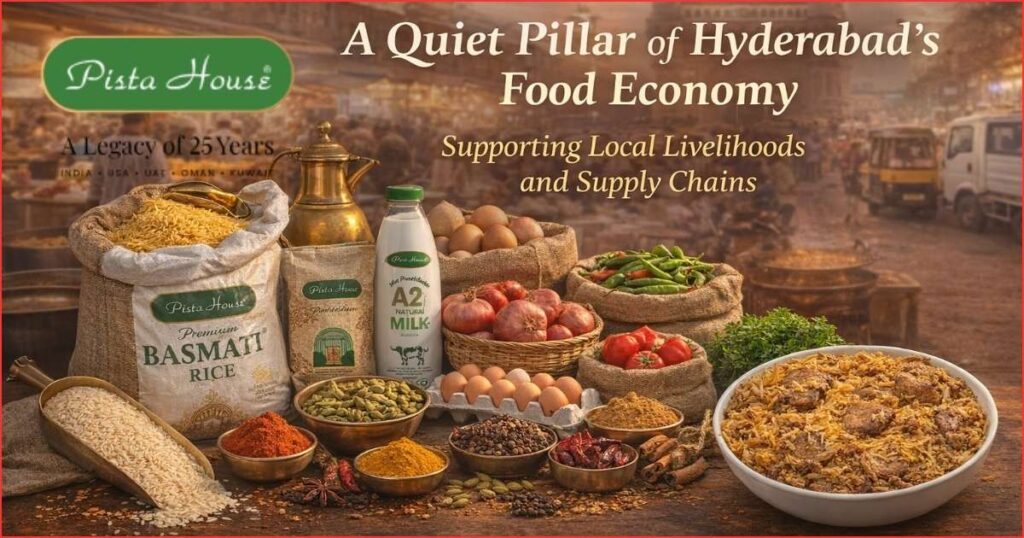
Hyderabad: The Pista House food economy role supported livelihoods, supply chains and seasonal demand across Hyderabad’s expanding food sector over the years.
In a city known for its cuisine, the brand’s contribution extended beyond dining. Its operations connected labour, sourcing networks and cultural cycles. As a result, it became part of a broader economic system rather than remaining limited to food service.
At the core, the business generated steady employment. Kitchens, bakeries and service counters required trained staff. Logistics and administrative roles added further layers to the workforce. Therefore, the Pista House food economy presence created stability in an industry often marked by frequent job changes.
This continuity helped workers build skills. Traditional cooking methods required time and practice. Long-term employment allowed employees to refine these techniques instead of shifting roles quickly. Consequently, skill retention remained stronger within the system.
Pista House food economy strengthened supply chain networks
Beyond direct jobs, the brand sustained an extensive supply chain. Ingredients such as grains, spices and dairy products moved through regional networks. These links connected rural producers with urban demand in Hyderabad.
Seasonal demand amplified this network. During peak periods, procurement increased sharply. Wholesalers, transporters and service providers all benefited from this rise in activity. Thus, the Pista House food economy influence extended to multiple layers of commerce.
Ramadan played a central role in this cycle. Preparations began weeks in advance, with higher purchasing volumes and expanded staffing. For many small suppliers, this season provided predictable income. The structured coordination behind these operations ensured that demand was met without disruption.
The scale of preparation reflected organisational depth. What appeared as smooth service to customers depended on careful planning and timing. This alignment reinforced the brand’s reliability within the city’s food system.
Pista House food economy shaped neighbourhood activity
The brand’s outlets also influenced local economies. Locations across different neighbourhoods attracted steady footfall. As a result, nearby businesses experienced increased activity.
Retail shops, small eateries and transport services benefited from this presence. Customers visiting one outlet often engaged with surrounding establishments. Therefore, the Pista House food economy contribution extended into micro-level urban interactions.
This clustering effect illustrated how food businesses could anchor commercial zones. It also showed how consistent customer movement supported smaller enterprises in the vicinity.
At a broader level, the brand’s growth reflected Hyderabad’s changing consumption patterns. Traditional dining coexisted with takeaway services and large-scale catering. By serving multiple segments, the business sustained demand across varied preferences and budgets.
Another dimension of impact lay in knowledge preservation. Traditional recipes and cooking techniques represented valuable expertise. By maintaining these practices in active kitchens, the brand ensured their continued relevance. This approach supported culinary professions that depended on skill rather than speed.
Importantly, the Pista House food economy role was defined by integration. Its operations linked labour markets, cultural events and supply systems. This interconnected model strengthened resilience within the local economy.
In Hyderabad’s dynamic food landscape, long-standing businesses often operated without visibility in trend-driven discussions. However, their contribution remained critical. By sustaining employment, enabling supply chains and reinforcing daily commerce, the Pista House presence became embedded in the city’s economic fabric.
About The Author