
Ispahani Tea: a Hyderabad legacy defined by continuity, discipline and structured growth
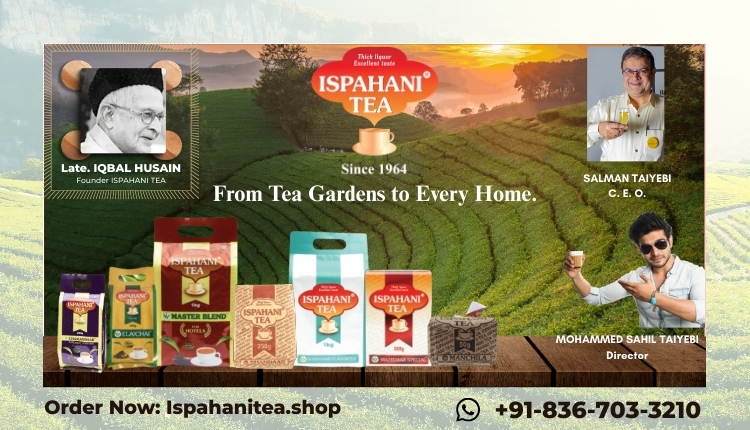
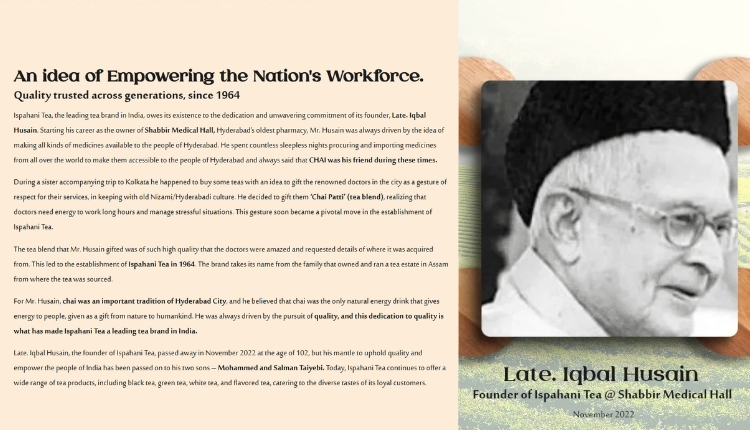
The origins of Ispahani Tea in 1964 can be traced directly to the personal convictions of its founder, Iqbal Hussain. Unlike many entrepreneurs who enter consumer markets through trading backgrounds, Hussain was a trained pharmacist. His professional grounding influenced the manner in which he approached business – with precision, discipline and a strong sense of responsibility.
Hussain believed that products used in everyday life held a deeper social role. They shaped routines, influenced moods and often became silent participants in cultural rituals. Tea, in particular, occupied a central place in his thinking. In Indian society, and especially in Hyderabad, tea functioned as more than a beverage. It served as a morning stimulant, a companion during long hours of work and a shared experience during conversation.
A significant turning point occurred when Hussain gifted carefully selected premium tea blends to doctors in Kolkata as a gesture of appreciation. The feedback he received was clear and instructive. The recipients valued the rare combination of strength, aroma and consistency in the blends. Their response highlighted a gap in the market – a demand for tea that delivered uniform quality without variation.
Encouraged by this realisation, Hussain founded Ispahani Tea in Hyderabad. The city’s deeply embedded chai culture made it an ideal base. From the beginning, the company’s direction was defined by structure rather than speed. Stable sourcing practices were established. Uniform blending methods were implemented. Quality checks were emphasised. Hussain consciously avoided shortcuts and refrained from aggressive marketing campaigns.
His belief was that trust earned through consistency would prove more durable than rapid expansion driven by publicity. This philosophy became the brand’s foundational pillar.
Gradual expansion anchored in reliability
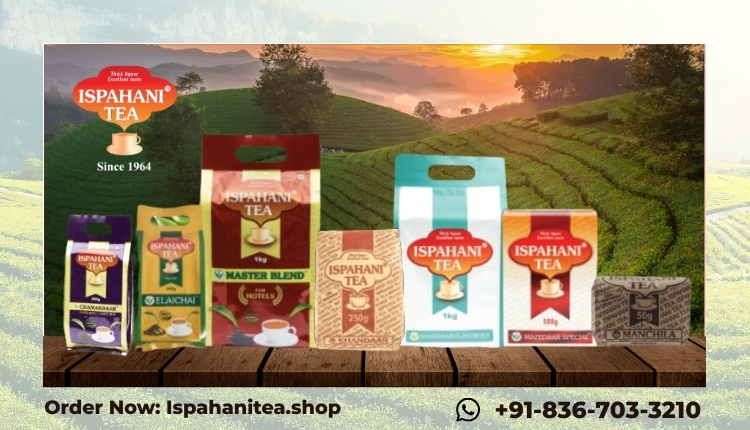
In its formative decades, Ispahani Tea expanded through measured consolidation. The strategy did not revolve around sudden national visibility or large-scale promotional drives. Instead, the focus remained on strengthening distribution within Hyderabad and neighbouring markets.
Retail partnerships were built carefully. Tea stalls, kirana stores and neighbourhood outlets became important channels for repeat consumption. In these environments, reliability mattered more than novelty. Customers who experienced consistent flavour often returned without hesitation.
By the late 1980s and early 1990s, Ispahani Tea had developed a structured distribution presence across the Old City, newly developing residential areas and commercial centres. During this period, the brand secured its identity as a dependable everyday tea. It appealed strongly to working households and small businesses that prioritised steady taste and affordability.
This phase did not involve dramatic repositioning. Rather, it represented the strengthening of a stable base built on familiarity and trust.
Generational leadership and operational refinement
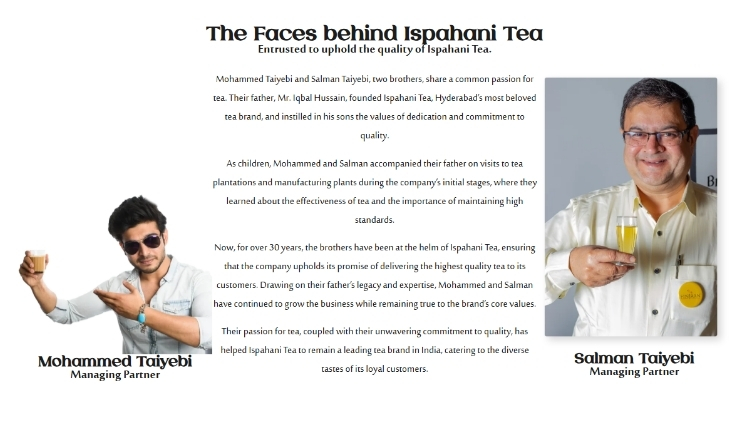
The transition to second-generation leadership marked an important stage in the company’s evolution. Mohammed Taiyebi and Salman Taiyebi, sons of the founder, assumed stewardship of the brand with complementary responsibilities.
Mohammed Taiyebi concentrated on internal strengthening. His role focused on enhancing supplier relationships, formalising operational processes and ensuring that scaling efforts did not compromise blending standards. As volumes increased, he safeguarded the original taste profile. Packaging systems were upgraded and supply chain management was reinforced.
Salman Taiyebi directed attention towards brand visibility and consumer engagement. Recognising changes in urban retail environments, he helped expand the brand’s presence beyond traditional packaged formats. His approach emphasised experiential touchpoints and enhanced retail presentation.
The collaboration between operational discipline and market-facing innovation enabled Ispahani Tea to modernise without losing its foundational character.
Portfolio depth and strategic extensions
Today, Ispahani Tea’s product portfolio reflects a layered architecture. Its primary offerings remain strong black tea blends sourced from Assam, Darjeeling and the Nilgiris. These blends cater to high-frequency daily consumption and represent the brand’s core demand segment.
In response to evolving preferences, the company introduced green and white tea variants aimed at consumers seeking lighter or health-oriented alternatives. These additions broadened the brand’s reach while maintaining quality benchmarks.
A notable expansion occurred with the launch of Finjaan in 2002. Positioned as a premium and wellness-focused line, Finjaan offers herbal and speciality blends suited for curated consumption and gifting. This sub-brand allowed Ispahani Tea to enter higher-value segments without diluting its mass-market identity.
Another strategic initiative is Bhai ki Chai, a café-style concept that frames tea as a social experience. Rooted in familiar taste profiles but delivered through contemporary presentation, Bhai ki Chai connects the brand to younger and urban audiences. This diversification illustrates adaptive growth while retaining continuity.
Experiential retail and flagship presence
A landmark moment in the company’s trajectory came in 2022 with the opening of its first flagship retail outlet at Mir Alam Mandi in Hyderabad’s Old City. The location symbolised continuity with the brand’s origins. Establishing the flagship within a historic market signalled confidence in traditional customer bases.
The flagship store functions as an integrated brand environment. It brings together classic Ispahani blends, Finjaan speciality teas and experiential components linked to Bhai ki Chai. This development marked a strategic move towards direct engagement with consumers through owned retail spaces.
It also reflected the brand’s readiness to combine heritage positioning with contemporary retail formats.
Key milestones
• 1964: Ispahani Tea founded in Hyderabad by Iqbal Hussain
• 1967: Introduction of early flavoured tea variants
• 1990: Expansion of structured distribution across Hyderabad
• 2002: Launch of Finjaan herbal and speciality tea range
• 2022: Opening of the first flagship store at Mir Alam Mandi
Position within Hyderabad’s tea culture
Within Hyderabad’s diverse beverage ecosystem, Ispahani Tea holds a distinct place. It is neither positioned as a transient trend nor confined to exclusive luxury status. Instead, it occupies the space of a stable, volume-driven brand integrated into daily routines.
Hyderabad’s tea culture is shaped by extended work schedules, neighbourhood interactions and dense commercial activity. In such an environment, brand loyalty often develops through repeated experience rather than advertising narratives. Ispahani Tea’s longevity is closely tied to this behavioural pattern.
Over decades, the brand has evolved in parallel with the city’s expansion, maintaining relevance across demographic and economic segments.
Franchise pathway and business proposition
The company’s current growth strategy emphasises franchising as a structured mechanism for expansion. Its long operating history, diversified formats and established consumer recall make it a comparatively stable proposition for entrepreneurs.
Franchise partners benefit from six decades of brand trust, access to centralised sourcing and standardised blends, multiple retail formats ranging from packaged tea outlets to café-style concepts, and compatibility with high-frequency daily consumption. The model is scalable across residential and commercial zones.
Rather than depending exclusively on premium positioning, the franchise framework prioritises steady demand, operational clarity and repeat customers. This approach aligns with the brand’s long-standing philosophy of measured, sustainable growth.
A legacy anchored in continuity
From Iqbal Hussain’s disciplined foundation to the structured leadership of Mohammed Taiyebi and Salman Taiyebi, Ispahani Tea’s journey reflects continuity reinforced by adaptation. It is a brand shaped by Hyderabad’s culture and strengthened by generational stewardship.
As the enterprise expands through franchising and experiential retail, it continues to balance heritage with scalable growth. Ispahani Tea stands as a Hyderabad-born legacy built not on acceleration alone, but on sustained trust and disciplined enterprise evolution.
About The Author