
Hyderabad DCC warns Centre move on MGNREGS will hurt rural jobs and agriculture
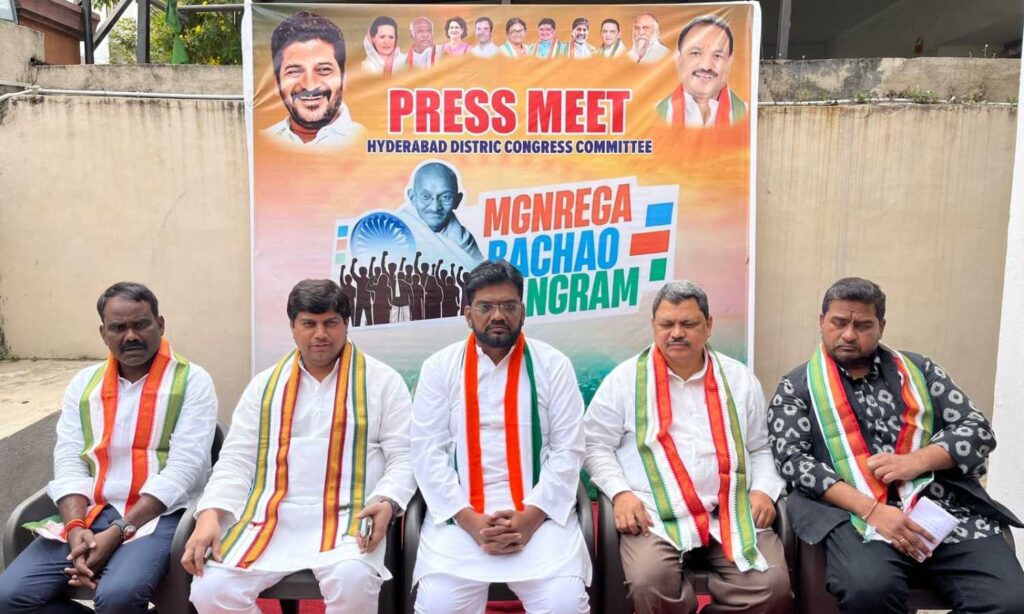
Hyderabad: The Hyderabad District Congress Committee on Saturday warned that any dilution of the Mahatma Gandhi National Rural Employment Guarantee Scheme would severely affect rural livelihoods, disrupt agriculture, and increase pressure on urban labour markets.
Addressing a press conference at Chintalkunta as part of a nationwide protest call given by the All India Congress Committee, Hyderabad DCC president Syed Khalid Saifullah accused the Centre of systematically weakening MGNREGS. He said the proposed changes amounted to an attack on the constitutional right to work and a deliberate attempt to dismantle a key social security legislation.
Congress Assembly in-charges Rajesh Kumar Pulipati (Bahadurpura), B. Nagesh (Chandrayangutta), Mohmmed Mujeebullah Shareef (Charminar), Shaik Akbar (Malakpet) and K. Ravi Raj (Yakutpura) also addressed the press conference and echoed concerns over the future of the scheme.
Saifullah said weakening MGNREGS would lead to large-scale migration from villages to cities, aggravating existing challenges related to employment, housing and infrastructure in urban centres. At the same time, he warned that rural areas would face an acute shortage of agricultural labour, directly affecting farming activity.
MGNREGS dilution to disrupt farm labour and wages, says DCC
The Hyderabad DCC president said crops such as paddy and vegetables would be particularly impacted due to the shortage of farm workers, leading to reduced output and higher prices. He said the fallout of MGNREGS dilution would extend beyond villages and affect the entire economic chain, including urban markets.
Explaining the original framework of the scheme, Saifullah said MGNREGS guaranteed every rural household 100 days of employment per year, with work to be provided on demand within a fixed time. The proposed changes, he alleged, would convert this legal right into a discretionary benefit controlled by the Union government.
He also raised concerns over wages, alleging that the new framework would allow arbitrary fixation, deny employment during peak agricultural seasons and weaken the bargaining power of rural workers. He further claimed that the authority of gram panchayats would be eroded, with decision-making becoming increasingly centralised and contractors re-entering the system.
Saifullah accused the Centre of shifting the financial burden onto States by requiring them to bear a larger share of wage payments. He warned that this could discourage States from generating employment under MGNREGS, shrinking rural job opportunities.
Referring to the Centre’s record, he alleged that MGNREGS wages had seen minimal increases despite inflation and that delays in payments had become routine. He also criticised Aadhaar-based payments and mobile monitoring systems, claiming they excluded genuine workers.
As part of the “MGNREGA Bachao Sangram”, Saifullah said the Congress would hold village-level meetings, push for gram sabha resolutions and conduct awareness campaigns nationwide. He reiterated demands for rollback of the proposed changes, restoration of the legal right to work, timely wages and a national minimum wage of ₹400.
About The Author